As a person with scoliosis, the primary goals of an exercise program for your spine should be to make the muscles of your back, shoulders, and upper back strong and flexible. (Quoted directly from this site) As your back muscles become stronger, your back will feel less tight and more flexible. In many cases, once your back muscles become stronger, your pain might decrease or at least become more manageable.
This site indeed has some good basic exercises for scoliosis patients, aiming to strengthen your back. They even have videos showing how the exercises are done.
Please bear in mind that you should only proceed if the exercises do not cause you discomfort or pain. And if you're worried, do talk to your doctors first. However, I've tried the exercises and found that they're light exercises, aimed to make strengthen your back and make your back feel good. They are not to exercises to 'correct' your curves, but they do make my spine feel more flexible and less taut/tight.
IMPORTANT TIPS for those just starting to exercise:
- Start slow. For instance, start with a 15 minute walk at moderate pace. Then slowly build up as you feel stronger. You could increase to 20 minutes at faster pace, then 30 minutes, and so on.
- When doing weights, start with light weights. I started off with just 1 kilo weights. Build up as you go, but never to the point of feeling pain on the spine.
- "Tingly" or "prickly" sensations around the back muscles when you first start your exercises is normal. But stabbing pain on the spine is NOT normal. Stop immediately if you feel any pain on the spine!
Lastly, I like what this site says about scoliosis and exercise:
"Scoliosis is not related to flexibility issues or lack of strength. Scoliosis does not act as a deterrent to normal physical activity. Children and teenagers with scoliosis can participate in sports and recreational activities. They can even perform normal exercises that help build muscle strength and endurance. They can even train to improve their cardiovascular conditioning like normal people."
Saturday, May 15, 2010


Friday, May 14, 2010
The Importance of Strengthening Your Back Muscles
I have so much to share but there is always so little time in a day!
But I've got a piece of good news and new discovery to share with my fellow scoliosis friends. Alright, maybe this discovery is not so new for some of us out there, but it is to me :)
About two months back, I discovered I had some free time in hand while the son is at playschool. So I decided to join the gym and get some serious workouts done.
I've always been a big believer in exercising. As a teenager I didn't really like physical activities because I was teased in school for wearing a bulky body brace, and for being so clumsy and not well-coordinated enough. Things were emotionally hard back then, so I didn't participate in sports much. If I had a regret about scoliosis, that would be it. I let the teasing and my lack of confidence get in the way and I wasted precious years not using vital parts of my body.
It wasn't until I was in college that I started brisk-walking and swimming on a daily basis in an effort to lose weight. I didn't lose weight much, but I was in good shape and felt good about myself. I had my first surgery within months of finishing my degree, and as soon as I could walk, I got my Dad or my then-boyfriend (now my husband) to drive me to Kiara Park so that I could walk. At first I walked so slow that everyone stared and wondered what was the matter with me. And at first it took me nearly 30 minutes to complete one round around the park. But I kept walking, sweating in my singlet and post-surgery body braces, not caring about those stares and whispers. And to this day I am glad I ignored them all!
Six months later I was out of the braces and walking 5 to 7 rounds (I took the big and uphill routes too) every single day. I had lost 15 kilos since the surgery and feeling good about myself.
Throughout my postgraduate studies in Melbourne, walking was my major exercise. A couple of years later when I felt super-strong, I started buying aerobic and strengthening workout videos to do on rainy winter days. I hiked a lot too on weekends and holidays. Hence I maintained my weight until I got pregnant with my son four years after my first surgery.
During my pregnancy I gained 16 kilos but kept active. I tried to workout three times a week throughout the pregnancy. After giving birth, it got hard to stick to an exercise plan. I was working and we were moving house, then the implants got infected and I couldn't walk for half a year. I started walking again when my son was 18 months old. That was when I decided to restart a workout schedule.
I walked at the park 5 days a week, 30 minutes each time. But it wasn't sufficient. My spine, and back muscles still didn't feel strong enough.
So now I've joined the gym. And to make full use of the gym, and to build strength on my back I have a personal trainer to train me twice a week. So every week while my son is at school (he goes to playschool three times a week), I'd be at the gym. Aside from that, I make sure I work out on my own home equipment three times a week. In total, I try to work out 6 days a week, about an hour to 2.5 hours each time.
And lo and behold, I am amazed at the strength that exercise can give us!
By us, I specifically mean us with scoliosis condition.
For the first time in 8 years, I am praying normally (standing up, with abilities to bend and prostrate as I wish). I can lift groceries, I can even lift my son (although I don't make a habit of it), I can bend down to look for things under the bed.. and so much more. My back muscles feel strong and capable of living a very-nearly-normal life. Praise God.
So what is my point here??
The point that I am trying to make is.. don't give up!
When you have scoliosis, some days the pain can drag you down. Some days it doesn't seem as if you will ever be normal or live normally. Some days there are just so many things that you cannot do.
Fight it.
Fight the pain. Exercise.
Go ahead, try it :)
Start with walking. Just walk. Go to the park and walk. Move your arms in silly ways that make you feel good and ignore those evil-starers. And don't stop for 30 minutes.
Stretch when you're done with your walking. Stretch your legs, your arms, your back. Be careful, but stretch. And feel good about your achievement. Because this will be the start of great benefits.
There are specific exercises to do to help strengthen the back muscles. I'm not talking about strengthening the spine or exercising your curves. What I mean is, if you concentrate on strengthening your back muscles (those muscles surrounding your back area), you can minimise discomfort and pain, and you'll also find yourself feeling stronger and better about yourself.
If you're unsure and need help, do talk to your doctors and physiotherapists. Ask them about suitable exercises. If you can find it, find a trainer with experience in aiding scoliosis patients.
In the following weeks I'll take some pictures and talk about the back exercises that I do, for the sole purpose of sharing personal experience and giving an idea of the benefits exercise can give scoliosis patients.
Is there anybody out there who have inspiring stories of fitness or strength-related discoveries to share? We still have much to learn about how exercise can benefit our scoliosis condition!
But I've got a piece of good news and new discovery to share with my fellow scoliosis friends. Alright, maybe this discovery is not so new for some of us out there, but it is to me :)
About two months back, I discovered I had some free time in hand while the son is at playschool. So I decided to join the gym and get some serious workouts done.
I've always been a big believer in exercising. As a teenager I didn't really like physical activities because I was teased in school for wearing a bulky body brace, and for being so clumsy and not well-coordinated enough. Things were emotionally hard back then, so I didn't participate in sports much. If I had a regret about scoliosis, that would be it. I let the teasing and my lack of confidence get in the way and I wasted precious years not using vital parts of my body.
It wasn't until I was in college that I started brisk-walking and swimming on a daily basis in an effort to lose weight. I didn't lose weight much, but I was in good shape and felt good about myself. I had my first surgery within months of finishing my degree, and as soon as I could walk, I got my Dad or my then-boyfriend (now my husband) to drive me to Kiara Park so that I could walk. At first I walked so slow that everyone stared and wondered what was the matter with me. And at first it took me nearly 30 minutes to complete one round around the park. But I kept walking, sweating in my singlet and post-surgery body braces, not caring about those stares and whispers. And to this day I am glad I ignored them all!
Six months later I was out of the braces and walking 5 to 7 rounds (I took the big and uphill routes too) every single day. I had lost 15 kilos since the surgery and feeling good about myself.
Throughout my postgraduate studies in Melbourne, walking was my major exercise. A couple of years later when I felt super-strong, I started buying aerobic and strengthening workout videos to do on rainy winter days. I hiked a lot too on weekends and holidays. Hence I maintained my weight until I got pregnant with my son four years after my first surgery.
During my pregnancy I gained 16 kilos but kept active. I tried to workout three times a week throughout the pregnancy. After giving birth, it got hard to stick to an exercise plan. I was working and we were moving house, then the implants got infected and I couldn't walk for half a year. I started walking again when my son was 18 months old. That was when I decided to restart a workout schedule.
I walked at the park 5 days a week, 30 minutes each time. But it wasn't sufficient. My spine, and back muscles still didn't feel strong enough.
So now I've joined the gym. And to make full use of the gym, and to build strength on my back I have a personal trainer to train me twice a week. So every week while my son is at school (he goes to playschool three times a week), I'd be at the gym. Aside from that, I make sure I work out on my own home equipment three times a week. In total, I try to work out 6 days a week, about an hour to 2.5 hours each time.
And lo and behold, I am amazed at the strength that exercise can give us!
By us, I specifically mean us with scoliosis condition.
For the first time in 8 years, I am praying normally (standing up, with abilities to bend and prostrate as I wish). I can lift groceries, I can even lift my son (although I don't make a habit of it), I can bend down to look for things under the bed.. and so much more. My back muscles feel strong and capable of living a very-nearly-normal life. Praise God.
So what is my point here??
The point that I am trying to make is.. don't give up!
When you have scoliosis, some days the pain can drag you down. Some days it doesn't seem as if you will ever be normal or live normally. Some days there are just so many things that you cannot do.
Fight it.
Fight the pain. Exercise.
Go ahead, try it :)
Start with walking. Just walk. Go to the park and walk. Move your arms in silly ways that make you feel good and ignore those evil-starers. And don't stop for 30 minutes.
Stretch when you're done with your walking. Stretch your legs, your arms, your back. Be careful, but stretch. And feel good about your achievement. Because this will be the start of great benefits.
There are specific exercises to do to help strengthen the back muscles. I'm not talking about strengthening the spine or exercising your curves. What I mean is, if you concentrate on strengthening your back muscles (those muscles surrounding your back area), you can minimise discomfort and pain, and you'll also find yourself feeling stronger and better about yourself.
If you're unsure and need help, do talk to your doctors and physiotherapists. Ask them about suitable exercises. If you can find it, find a trainer with experience in aiding scoliosis patients.
In the following weeks I'll take some pictures and talk about the back exercises that I do, for the sole purpose of sharing personal experience and giving an idea of the benefits exercise can give scoliosis patients.
Is there anybody out there who have inspiring stories of fitness or strength-related discoveries to share? We still have much to learn about how exercise can benefit our scoliosis condition!
Friday, March 19, 2010
The Importance of Diagnosing Scoliosis
I always believe that you are the expert of your own body.
Many people with Scoliosis out there have been diagnosed and have received treatments, or receiving treatments right now. But there are also many individuals out there who suspect, or know that there is something wrong with their bodies. With their spines. And everyday they live in worry or pain or even fear, because they are unsure of what to do.
This might come a little late, but lets look into some definitions of what "Scoliosis" is. Before I begin, again please bear in mind that this site is not a medical site. All contents are based on personal experience, personal research and personal opinions. So please forgive any mistakes on my part and I welcome inputs from better-informed individuals :)

The illustrations above show the different types of Scoliosis curves. Curves can be thoracic (upper spine), lumbar (lower spine) or even thoracic-lumbar (involving both the upper and lower spine). Patients with Scoliosis might have a curve curving to the right side of their bodies, or to the left, or both (in S-shaped cases). Some people have slight curves which some doctors would choose to monitor, or treat with bracing. Some people have moderate to severe curves that require bracing or even surgery.
The point that I am trying to make is that each person's Scoliosis is unique.
And this leads me to the next point...
This unique reason is why it is very VERY important to get proper diagnosis for your Scoliosis.
By proper diagnosis I mean a diagnosis made by a spinal specialist, a doctor who can tell you exactly what your curves look like, how un-severe or severe it is, and what treatment options are there for you specific situation.
My friends, going to the doctor and hearing their explanation can sometimes be a daunting prospect. Scary, even. But getting a proper diagnosis for your condition is vital because only then you can decide which course of action to take for yourself.
Noone can force you to wear the braces or have a surgery. Not even a frightening-looking doctor. Forgive me, dear doctors; please know this is not a personal attack on doctors as a whole!
What I am trying to say is that it is important to know the reality of the situation you are facing, and what might lay in the future for you if actions are not taken.
Don't postpone your diagnosis. Don't postpone hearing your treatment options. Because one day you may very well regret it.
Today your condition may be treatable. Today your condition may allow you to live like a normal person.
But ten years from now the pain may be severe. Ten years from now the curves may have doubled. Ten years from now you might have to resort to corrective treatments which could have been avoided if you are treated now.
Trust me on this. I know this because I've made that mistake before.
Back in 1994, they said I needed a surgery. My curves were about 50 degrees back then, and although I did experience some pain on a daily basis, it wasn't anything I could handle.
By 2002, my curves had progressed to between 80-95 degrees each. I had a huge hump on my back (I looked like the Hunchback of Notredam), clothes didn't fit well at all, and worst of all was that I had pain every single day. It hurt to exercise. It hurt to breathe sometimes (because the curve was pressing against my lungs).
In life there is no "should have", "could have" or "would have". You cannot look back and change things even if you wanted to.
So.. as daunting as it may seem... go get a diagnosis.
And then, where you choose to go from there is entirely up to you. Noone can force you to do anything you are not willing to. But this is something you can do for yourself.
You can learn the truth and deal with it now, rather than kicking yourself in the hind region perhaps ten years down the line.
Many people with Scoliosis out there have been diagnosed and have received treatments, or receiving treatments right now. But there are also many individuals out there who suspect, or know that there is something wrong with their bodies. With their spines. And everyday they live in worry or pain or even fear, because they are unsure of what to do.
This might come a little late, but lets look into some definitions of what "Scoliosis" is. Before I begin, again please bear in mind that this site is not a medical site. All contents are based on personal experience, personal research and personal opinions. So please forgive any mistakes on my part and I welcome inputs from better-informed individuals :)
This wikipedia article gives a simple but thorough explanation of what Scoliosis is.
From the article, we concur that Scoliosis is a medical condition in which a person's spine is curved, from side to side. The two common curves for Scoliosis patients are usually either "S"-shaped curve, or "C"-shaped curve.
The first thing that Scoliosis patients must realise is that every two patients' curves are not the same. The curves, its severity, its degree, and the discomfort or even pain that a patient goes through is not similar and alike to all other patients.
Lets take a look at the different curves pictured below.


The illustrations above show the different types of Scoliosis curves. Curves can be thoracic (upper spine), lumbar (lower spine) or even thoracic-lumbar (involving both the upper and lower spine). Patients with Scoliosis might have a curve curving to the right side of their bodies, or to the left, or both (in S-shaped cases). Some people have slight curves which some doctors would choose to monitor, or treat with bracing. Some people have moderate to severe curves that require bracing or even surgery.
The point that I am trying to make is that each person's Scoliosis is unique.
And this leads me to the next point...
This unique reason is why it is very VERY important to get proper diagnosis for your Scoliosis.
By proper diagnosis I mean a diagnosis made by a spinal specialist, a doctor who can tell you exactly what your curves look like, how un-severe or severe it is, and what treatment options are there for you specific situation.
My friends, going to the doctor and hearing their explanation can sometimes be a daunting prospect. Scary, even. But getting a proper diagnosis for your condition is vital because only then you can decide which course of action to take for yourself.
Noone can force you to wear the braces or have a surgery. Not even a frightening-looking doctor. Forgive me, dear doctors; please know this is not a personal attack on doctors as a whole!
What I am trying to say is that it is important to know the reality of the situation you are facing, and what might lay in the future for you if actions are not taken.
Don't postpone your diagnosis. Don't postpone hearing your treatment options. Because one day you may very well regret it.
Today your condition may be treatable. Today your condition may allow you to live like a normal person.
But ten years from now the pain may be severe. Ten years from now the curves may have doubled. Ten years from now you might have to resort to corrective treatments which could have been avoided if you are treated now.
Trust me on this. I know this because I've made that mistake before.
Back in 1994, they said I needed a surgery. My curves were about 50 degrees back then, and although I did experience some pain on a daily basis, it wasn't anything I could handle.
By 2002, my curves had progressed to between 80-95 degrees each. I had a huge hump on my back (I looked like the Hunchback of Notredam), clothes didn't fit well at all, and worst of all was that I had pain every single day. It hurt to exercise. It hurt to breathe sometimes (because the curve was pressing against my lungs).
In life there is no "should have", "could have" or "would have". You cannot look back and change things even if you wanted to.
So.. as daunting as it may seem... go get a diagnosis.
And then, where you choose to go from there is entirely up to you. Noone can force you to do anything you are not willing to. But this is something you can do for yourself.
You can learn the truth and deal with it now, rather than kicking yourself in the hind region perhaps ten years down the line.
Thursday, March 11, 2010
Tips on Wearing Body Braces to School
Many have asked me about how it is like for a teenager to wear braces nearly 24 hours a day. Many have also asked for advice on how to make braces-wearing easier.
The truth is that I cannot speak for all patients who've experienced bracing. I can only speak of myself and share my experience with others. And because each of us has somewhat different experiences, that is why it is so important for us to share stories and information... because maybe our stories and experiences would be useful and insightful to others who are going through similar situations.
So lets talk about wearing braces to school.
This is Malaysia. It's hot, humid and sticky here. Tourists come here to parade around in sleeveless or shorts and bikini tops.
The last thing any girl (or boy) wants to do is wear a hard, thick plastic corset under those warm layers of school uniforms.
Our friend Twilight Princess (I hope you don't mind me quoting you here) mentioned that she wears the SpineCor brace. I Googled it and this is what I found.

Apparently SpineCor braces are dynamic braces which allow more flexibility in movements as compared to older braces made of hard plastics and metal.
But let's face it. The truth that we cannot deny is that no matter how "flexible" or "dynamic" braces are... braces are still braces.
Braces brace your body. They have a job to do. That job is to hold your spine in place, to ensure that your curves are managed and not worsen.
The following is a detailed photo of a SpineCor brace.

These photos are put here as illustrations to show what we have to put on our bodies. These braces made of synthetic materials which should be worn above cotton singlets or cotton t-shirts should ideally go underneath your day-to-day clothes because noone really wants to go around wearing braces over their day clothes. So that's how I wore it; I wore a cotton singlet under the braces to help absorb sweat and minimize abrasion on the skin, and over the braces I wore my normal clothes. So when I went to school, I wore my school baju kurung above the braces.
I'm sure seasoned braces-wearers know all this already ;)
Okay, so below here are some tips on wearing braces to school on a daily basis. Anyone out there who would like to add their own tips, please feel free to add to this content in the comment box. Thanks!
The truth is that I cannot speak for all patients who've experienced bracing. I can only speak of myself and share my experience with others. And because each of us has somewhat different experiences, that is why it is so important for us to share stories and information... because maybe our stories and experiences would be useful and insightful to others who are going through similar situations.
So lets talk about wearing braces to school.
This is Malaysia. It's hot, humid and sticky here. Tourists come here to parade around in sleeveless or shorts and bikini tops.
The last thing any girl (or boy) wants to do is wear a hard, thick plastic corset under those warm layers of school uniforms.
Our friend Twilight Princess (I hope you don't mind me quoting you here) mentioned that she wears the SpineCor brace. I Googled it and this is what I found.

Apparently SpineCor braces are dynamic braces which allow more flexibility in movements as compared to older braces made of hard plastics and metal.
But let's face it. The truth that we cannot deny is that no matter how "flexible" or "dynamic" braces are... braces are still braces.
Braces brace your body. They have a job to do. That job is to hold your spine in place, to ensure that your curves are managed and not worsen.
The following is a detailed photo of a SpineCor brace.

These photos are put here as illustrations to show what we have to put on our bodies. These braces made of synthetic materials which should be worn above cotton singlets or cotton t-shirts should ideally go underneath your day-to-day clothes because noone really wants to go around wearing braces over their day clothes. So that's how I wore it; I wore a cotton singlet under the braces to help absorb sweat and minimize abrasion on the skin, and over the braces I wore my normal clothes. So when I went to school, I wore my school baju kurung above the braces.
I'm sure seasoned braces-wearers know all this already ;)
Okay, so below here are some tips on wearing braces to school on a daily basis. Anyone out there who would like to add their own tips, please feel free to add to this content in the comment box. Thanks!
- Choose comfortable, absorbent camisoles/singlets or thin t-shirts (preferably ones that are body-fitting) to be worn underneath the braces. Loose singlets/t-shirts are less comfortable because the braces are made skin-tight (molded to your body) and if you wear a loose undergarment, they'll create folds under the tight braces and once you start sweating, the folds of the clothes could eventually cause discomfort and itchiness. So try to look for cotton singlets that cover all surfaces of your body which the braces covers. As shown in the pictures above, the girl is wearing a nice fitting t-shirt which covers all the parts of her body that the braces covers. If there are parts of your body which comes in direct contact with the braces, it can be quite uncomfortable because sweat could make skin in that area become red and itchy.
- Do have a soothing balm or lotion at hand. The braces could cause redness and itchiness on your skin, and you will feel this mainly when you take off the braces. I personally used a lot of aloe vera gel and vitamin E lotion. Sometimes I had rashes because of the heat and sweat, and I found that putting on medicated powder before you put on the braces, and then putting some aloe gel after you take off the braces (on the red areas created by the tightness of the braces) seemed to help ease the rash. Of course different stuff works for different people. In time you'll find what works best for you.
- Bear in mind that there are just some activities that are somewhat too uncomfortable for you to do with braces on and it's okay to admit this to the teachers. School is a hot and uncomfortable place most days for braces-wearers. This may seem like an unappealing or embarrassing idea, but letting your teachers know your condition can be very very helpful. Granted, as a teenager I did use the scoliosis excuse to get out of unpleasant activities such as playing netball under a 40 degree sun.. (hahaa) but the reality is some teachers can be supportive and helpful. And the ones who aren't should be ashamed of themselves! Hehh.. that's the reality of life, folks. For instance, when I was 13 and 14 years old, I was in the evening session. On Mondays we used to have "perhimpunan" in the courtyard, right there under the hot afternoon sun. Sometimes the heat just got too much for me and I had to ask to sit at the canteen, out of the sun. Yesss I will not deny that being singled out made me feel like a freak sometimes, but it was better to face the reality of the situation rather than making a scene of fainting right there in the middle of the perhimpunan! Right? So... do try to realise what you can and cannot do, and don't be ashamed to admit it.
- Try to arrange for an occasional "time-off" period for important sports activities and such, if necessary. For instance, for sports activities (what we used to call as PJ; Pendidikan Jasmani, or for extra-curricular activities), my mom used to allow some "time off" from wearing the braces. You could say those were the highlights of my days ;) For extra-curricular activities (house practice, sports society/club and such), I'd leave the braces at home, Dad would send me to school and fetch me afterwards, then I'd wear the braces again once I got home. PJ was another different matter though. It was tough convincing my parents to let me go to school the whole day without the braces, so after much sulking (on both parts) we reached a compromise. I joined the class for PJ in the fields every alternate week. One week I'd be allowed to go to school without braces on days that had PJ classes. Then the next week I would have to sit in the shades while I watched my friends play netball because it was too hot and uncomfortable for me to join any strenuous exercise activities with the uncomfortable Milwaukee and Boston braces on. Why is "time-off" an important option for you to consider? Because wearing braces should not mean that you must stop your favourite activities or put your life on halt. It's important to continue pursuing your hobbies, just remember to plan your schedule, and plan ahead.
And then there's of course the issue of your emotional state of mind when wearing the braces to school. But that's another story altogether, so we'll talk about that in another entry.
So do share your tips, people. Braces-wearing doesn't have to be a miserable, imprisoning ordeal if we manage it well, God willing! :)
Friday, March 5, 2010
Of Hopes and Dreams of a Scoliosis Patient
Today I finally managed to see Dr. Azmi of HUKM at Pusat Pakar HUKM. In reality I realise there is little need to see the doctors now that the implants have been taken out and I've gained full recovery. But to appease my ever-worried parents (and spouse), I chose to go over, at least for a chat.
And of course, there is that main underlaying reason that has been nagging at me for years. The hope and the dream of building a support network for young Malaysian with Scoliosis.
In hopes that they would not feel alone and know there are many others out there like them. In hopes that one day Malaysians would be aware of Scoliosis and respect (and understand!) those with this condition. In hopes that one day no young person has to go through what I personally went through as a teenager with Scoliosis.
The man who had skillfully operated on me and changed my life, Professor Muhamad Razak, does not hold clinics anymore. So off I went to see Dr. Azmi, the man who was there for my second surgery (implant removal) back in 2008. And here I will unabashedly admit that Dr. Azmi was also the man who had to tolerate my blabbering nonsense of chaos and panic back in that brightly lit operating theatre, as all my inner demons had surfaced then and reared their ugly heads.
We had an encouraging chat. The good doctor is supportive of the idea for a Scoliosis Support Network. I am hopeful that one day soon it will become a reality.
I am told that there is no need for an annual check-up, no need for anymore x-rays, no need for anymore physiotherapy, as long as I experience no pain on a day-to-day basis.
I very nearly got a lump at the back of my throat which had to be swallowed back (hard) upon seeing Prof Mat's scrawl of "Fully Recovered" right there on the last page of my file. If you've gone through 20 years of scoliosis treatments, pains and problems as I did, and I'm sure many of you out there did.. I'm sure you'd understand that there are moments when triumph and gladness can cause those lumps-at-the-back-of-your-throat to occur :)
Praise God. Dare I say that after 20 years, I can now live as normally as any other ordinary Jane can. Live without the fear of the curves digressing, without the fear of further surgeries, without so many nagging fears that I'd rather not go into right here, else I'd sound like a constantly whining ungrateful witch.
This blog had always been about my personal experience, and yet thus far I'd restrained writing in a very personal manner, as an attempt to stay objective on the subject of Scoliosis.
But lately I've realised, there is no separating Scoliosis from my personal emotions and wellbeing. Scoliosis is in you, it makes you the person that you are because you live your whole life with it and you can't run away from it. If you're a scoliosis patient, scoliosis is you.
This is not a site of a medical expert. My opinions are shallow and from the perspective of a Scoliosis patient, 31 years of age, first diagnosed with Scoliosis at the age of 12.
I will continue writing on things that are relevant to all Scoliosis patients out there, in hopes of reaching out through sharing of information and personal experiences. And I hope those of you out there will share your experiences with me as well.
Because this can be the start of something great.

And of course, there is that main underlaying reason that has been nagging at me for years. The hope and the dream of building a support network for young Malaysian with Scoliosis.
In hopes that they would not feel alone and know there are many others out there like them. In hopes that one day Malaysians would be aware of Scoliosis and respect (and understand!) those with this condition. In hopes that one day no young person has to go through what I personally went through as a teenager with Scoliosis.
The man who had skillfully operated on me and changed my life, Professor Muhamad Razak, does not hold clinics anymore. So off I went to see Dr. Azmi, the man who was there for my second surgery (implant removal) back in 2008. And here I will unabashedly admit that Dr. Azmi was also the man who had to tolerate my blabbering nonsense of chaos and panic back in that brightly lit operating theatre, as all my inner demons had surfaced then and reared their ugly heads.
We had an encouraging chat. The good doctor is supportive of the idea for a Scoliosis Support Network. I am hopeful that one day soon it will become a reality.
I am told that there is no need for an annual check-up, no need for anymore x-rays, no need for anymore physiotherapy, as long as I experience no pain on a day-to-day basis.
I very nearly got a lump at the back of my throat which had to be swallowed back (hard) upon seeing Prof Mat's scrawl of "Fully Recovered" right there on the last page of my file. If you've gone through 20 years of scoliosis treatments, pains and problems as I did, and I'm sure many of you out there did.. I'm sure you'd understand that there are moments when triumph and gladness can cause those lumps-at-the-back-of-your-throat to occur :)
Praise God. Dare I say that after 20 years, I can now live as normally as any other ordinary Jane can. Live without the fear of the curves digressing, without the fear of further surgeries, without so many nagging fears that I'd rather not go into right here, else I'd sound like a constantly whining ungrateful witch.
This blog had always been about my personal experience, and yet thus far I'd restrained writing in a very personal manner, as an attempt to stay objective on the subject of Scoliosis.
But lately I've realised, there is no separating Scoliosis from my personal emotions and wellbeing. Scoliosis is in you, it makes you the person that you are because you live your whole life with it and you can't run away from it. If you're a scoliosis patient, scoliosis is you.
This is not a site of a medical expert. My opinions are shallow and from the perspective of a Scoliosis patient, 31 years of age, first diagnosed with Scoliosis at the age of 12.
I will continue writing on things that are relevant to all Scoliosis patients out there, in hopes of reaching out through sharing of information and personal experiences. And I hope those of you out there will share your experiences with me as well.
Because this can be the start of something great.

Saturday, January 16, 2010
Apologies for Hiatus
Thousand apologies for the long hiatus from this blog! I think about this blog often, it's just that time hasn't been on my side lately due to personal reasons. I don't get really personal in this blog because this blog is supposed to be dedicated to topics related to scoliosis. But I suppose one can't avoid the "personals" sometimes. To make a long story short, life at home has been challenging and yet enlightening for a few months now since our maid ran off. And yes, that's the reason why this blog has been neglected for so long and all the comments left unreplied. Again, my apologies.
I hope the year will bring more productiveness and that this blog will not be neglected again. God willing :)
I hope the year will bring more productiveness and that this blog will not be neglected again. God willing :)
Wednesday, August 12, 2009
The Titanium Implants
First and foremost, thank you to those who visited this blog and left your comments. Please please don't hesitate to get in touch with me (my email address is available here) because this condition that we have can be a very hard thing to handle on our own. Perhaps by building a network, we can be there for one another and feel a little less lonely about suffering from Scoliosis.
There is a need to reach out and talk about things we don't get to talk about with our everyday friends (and family) who don't experience Scoliosis, and my aim here is to share my personal experiences as a Scoliosis patient. I hope one day others will share their experiences here too.
I talked about the titanium implants in my personal blog. If you've the time and wish to know about removal of titanium implants, do give it a read.
FYI, I had my fusion in October 2002, and had the implants removed due to infection in April 2008. A screw had broken and caused the implants to become loose (in laymen's terms). The area surrounding the implants became infected, and there were some symptoms involved.
Here I'd like to talk about the symptoms I experienced when infection developed due to the titanium implants. Perhaps this will be helpful to someone out there some day.
The first thing that I noticed was that my spine started hurting more and more. I'd given birth in December 2006, and by December 2007, I was experiencing pain nearly 24 hours a day. I thought it was because I was overdoing it. Our boy was hefty so I attributed the pain to the fact that I was always carrying him, so that was why the good ol' spine was always in pain. It's difficult to explain how the pain was like, but if you've had surgery and have implants on your spine, you'd know what I mean when I explain it like this.. it as if the implants were starting to bother me a lot more and the areas around the implants would throb and sometimes there were sharp pains that came suddenly.
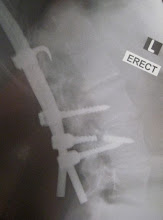
By January 2008, I started developing high fever. The fever came on a daily basis, only subsiding whenever I took paracetamols. They did blood tests and at first could not find anything wrong. A month later I was still having fever everyday. A blood test at Assunta Hospital showed that there is infection somewhere in my body, but they could not detect the source. Then an x-ray showed me my worst fear; one of the screws on my spine had broken and the doctors suspected that that is causing infection in the surrounding area.

I frankly could not comprehend the news. It was difficult to accept the fact that they would have to open me up again, this time to remove the implants. Putting them in there was VERY painful. The pain is something I was not willing to go through again. Therefore I opted to see my surgeon (Prof Muhamad Razak, HUKM) to discuss pain management. At that time, removal of the implants was not an option for me.
By end of February I was on pain meds (Arcoxia being the drug of choice). The pain however did not go away. Even with the medication, I hardly slept because of the pain. It was difficult to get out of bed and work.
By March the pain had spread down my left leg and my left leg started losing sensation. By April I could hardly walk and had to be supported by family members when walking. I fell many times because the left leg could not support my weight and the right leg was getting weaker as well.
So in the end, a surgery was performed to take the implants out. The broken end of the screw, however, is still here in me.

There is a need to reach out and talk about things we don't get to talk about with our everyday friends (and family) who don't experience Scoliosis, and my aim here is to share my personal experiences as a Scoliosis patient. I hope one day others will share their experiences here too.
I talked about the titanium implants in my personal blog. If you've the time and wish to know about removal of titanium implants, do give it a read.
FYI, I had my fusion in October 2002, and had the implants removed due to infection in April 2008. A screw had broken and caused the implants to become loose (in laymen's terms). The area surrounding the implants became infected, and there were some symptoms involved.
Here I'd like to talk about the symptoms I experienced when infection developed due to the titanium implants. Perhaps this will be helpful to someone out there some day.
The first thing that I noticed was that my spine started hurting more and more. I'd given birth in December 2006, and by December 2007, I was experiencing pain nearly 24 hours a day. I thought it was because I was overdoing it. Our boy was hefty so I attributed the pain to the fact that I was always carrying him, so that was why the good ol' spine was always in pain. It's difficult to explain how the pain was like, but if you've had surgery and have implants on your spine, you'd know what I mean when I explain it like this.. it as if the implants were starting to bother me a lot more and the areas around the implants would throb and sometimes there were sharp pains that came suddenly.
By January 2008, I started developing high fever. The fever came on a daily basis, only subsiding whenever I took paracetamols. They did blood tests and at first could not find anything wrong. A month later I was still having fever everyday. A blood test at Assunta Hospital showed that there is infection somewhere in my body, but they could not detect the source. Then an x-ray showed me my worst fear; one of the screws on my spine had broken and the doctors suspected that that is causing infection in the surrounding area.

I frankly could not comprehend the news. It was difficult to accept the fact that they would have to open me up again, this time to remove the implants. Putting them in there was VERY painful. The pain is something I was not willing to go through again. Therefore I opted to see my surgeon (Prof Muhamad Razak, HUKM) to discuss pain management. At that time, removal of the implants was not an option for me.
By end of February I was on pain meds (Arcoxia being the drug of choice). The pain however did not go away. Even with the medication, I hardly slept because of the pain. It was difficult to get out of bed and work.
By March the pain had spread down my left leg and my left leg started losing sensation. By April I could hardly walk and had to be supported by family members when walking. I fell many times because the left leg could not support my weight and the right leg was getting weaker as well.
So in the end, a surgery was performed to take the implants out. The broken end of the screw, however, is still here in me.

Subscribe to:
Posts (Atom)