Saturday, February 5, 2011

The Pain in The Neck

The trouble with living with Scoliosis is that oftentimes you think you've grown to the physical discomfort and pain that comes with having Scoliosis. Then sometimes life throws you a curve ball which tests your limitations, patience and faith.

The truth is not very spectacular, it's just a pain to deal with *ironic smile* :)

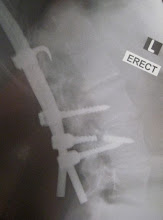
Earlier this week I woke up with severe pain in my neck (yes this does sound really odd, but it's true), which has not ceased since then. Malays would call it "seliuh bantal"; which basically means you'd sprained your neck while sleeping on your pillow. In other words; sprain your neck in your sleep. The trouble about having a sprained neck with this Scoliosis of mine is that it causes a whole lot of other pains. Not only the neck region is throbbing (spasming), my upper curve (i.e. the upper spine.. recall that my spine has the S-curve) as well as the rib hump they'd removed and repaired in the spinal fusion back in 2002 are hurting as well.

And here I thought I'd taken all the precautions to avoid any spine-related injuries! I use proper support pillows, sleep in proper sleeping positions (never on my stomach, never in positions that do not align the spine properly) and on top of that, I exercise the back regularly and try to get sufficient rest every night for the sake of the spine. And still somehow during the early hours of that fated night, I managed to give my neck a really bad sprain.

I went to an acupuncturist in Taman Megah here in Petaling Jaya and Alhamdulillah, the neck can move during the day. But the nights are still utter agony. This being the worst sprain I've had so far, I suppose it'll take time to heal.

If you think I'm moaning about it, well maybe you're right. But the truth is I just want to write about this as a reminder to all of us with Scoliosis.

It's so important for us to take precautions to avoid injuries. To never take for granted about the littlest thing in life, like sleeping positions or daily activities (like lifting a heavy item) that can hurt the spine. Because any injuries, combined with this existing condition that we have (Scoliosis) can bring severe pain and discomfort in our daily lives.

So take care of yourselves, dear friends. Live life, live strong, but live it carefully. May God be with you!

Saturday, December 18, 2010

Common Questions from Newly-Discovered Scoliosis Patients

Many people with Scoliosis email me through this blog and I must say, thank you so much for your emails and thank you for reaching out to a fellow friend with Scoliosis. For many of us, the questions that plague us are similar, although we may not know that.

Here I will try to lay out some questions that are most common, usually coming from those who have just discovered about their condition, or from those who know that they have Scoliosis but have not received treatments of any form for their condition.


Q: Where do I go to check my Scoliosis? Who do I see?

A: It is most usual and advisable for a Scoliosis patient to see a medical doctor, a specialist who specialises in spine. There are many orthopedic specialists out there, but I personally would go for a spinal specialist right away because they have sub-specialised in treating the spinal cord. There are many spinal specialists now in Malaysia, be it in government or private hospitals. If you choose a private hospital, you simply call in and set an appointment. I am not too sure about government hospitals, but nowadays I suspect you could do the same (call in and inquire about making an appointment with a spinal specialist).

You will need a referral letter from any doctor (just go to any clinic and tell the doctor that you have Scoliosis, and you need a "referral letter" from the doctor which specifies that you have Scoliosis and need to be checked by a specialist). This referral letter will be given to the specialist on the day of your appointment (you could make several copies of the letter if you choose to go to several different specialists to get more than one specialist' opinion).


Q: What happens during the first hospital check-up?

A: If it is your first check-up, they will send you to do x-rays on your spine. From the x-rays, the specialist will then tell you the condition and severity of your curve (the shape of your curve, single curve or double, non-severe, moderate, severe, etc.) and the degree(s) of your curve(s).


Q: What are the treatment options available?

A: The specialist will explain to you the options available to you (physiotherapy, bracing, surgery, etc.). He/She will recommend the treatment options for your specific condition.

But as a patient please note that there are other treatment options available as well. Many private clinics are available nowadays that provide physiotherapy, chiropractor services, acupuncture, and so on. Here's one example of such clinic. There are a few others out there, so please do your research. My knowledge of these treatments and the clinics available out there is limited, but for those who chose alternative treatments other than those suggested by your spinal specialist, please do intensive research before deciding on the course of action suitable for you.


Q: Will I need to go to surgery?

A: Again, this depends on many factors. It depends on the severity or seriousness of your curves, it also depends on your financial abilities, personal preference, and so on. For some, surgery might be the only solution (as I believe it was my only solution because my upper curve had exceeded 100 degrees back then).. but it may not be necessary if your curves are not severe, and if your spine does not get in the way of normal day-to-day living. Again this is my personal opinion on the matter. Even if your specialist suggests for you to do a surgery, noone can force you to take this step unless you yourself choose to do so.


Q: Will I feel better if I have a surgery?

A: No one will know for sure! Surgery is not a miraculous solution, it is not the end of the road that will heal all pain and problems. In my situation, surgery was necessary, but remember.. living with Scoliosis is a life-long condition. Choose a treatment option that suits you and your condition.

Q: Should I go for physiotherapy or bracing?

A: This is again up to your doctor, and you. The situation differs for every patient. Do not give up and keep trying. For some, physio and bracing work well. For some, surgery may be the answer. Some might even choose to forgo all these formal treatments provided at the hospital and opt for alternative treatments (chiropractor, acpuncture, etc.). I did physio and bracing for two years in my teenage years and it did not help me much as my curves were very progressive. But I know some people for whom physio has worked wonders in decreasing their pain and improving their daily lives. I also know of a few others for whom bracing worked well in containing and improving their curves. So in my opinion, it is really a matter of trial and error... and a lot of faith and luck as well.


Q: What if I do not get my Scoliosis treated at all?

A: Yes you can choose to do so. But in reality, if you have Scoliosis, you cannot run from the fact that it is a lifelong condition that you have to live with forever. At some point of your life you may feel discomfort or pain while doing daily activities. When or if this occurs, you must realise that it is necessary to take actions. Even the simplest action like exercising more to ease your daily pain is a good action!

******************************************************************

So there you have it.. the most common questions that I get asked about by those who have just discovered that they have Scoliosis, and those who have not had any treatments for their Scoliosis.

Thursday, December 2, 2010

Of Little Achievements

This year has been full of unexpected things.

What I mean is.. things that I didn't expect to be able to do as a person with scoliosis (and having had two surgeries already)... have materialised, much thanks to Allah.

You can read about them here.

I ran (more like brisk-walked and half-jogged!) and finished 6 marathons in the past 6 months :)

This week I went for a RPM / spinning class and I am super-excited about it. Never once in my life did I imagine that I'd one day have the ability to be a regular gym-goer.. and to be able to attend exercise classes, just as if I am fully normal. Praise God.

To my scoliosis friends our there who are going through hard times and feeling as if normality is so much out of reach.... please have faith. Have faith in yourself. Have faith in a Higher Being (whatever your religious believe might be, it doesn't matter.. have faith in a higher power..). Have faith, stay strong, and don't give up on the hope that one day normality will be within your grasp and in your life once again.

Trust me. I didn't even think I could walk again. Whatever negative feelings, depression, frustration, helplessness, anger, envy, hopelessness that you may feel... I've felt it too. And sometimes on bad days, the feelings still come knocking on my door.

And to my scoliosis friends who are living the very much sought-after normal life we often hope and pray for..

Let us say thanks and cherish these moments.. one day at a time :)

For who knows what tomorrow holds for us...?

Tuesday, August 10, 2010

Physiotherapy

Only a professional physiotherapist can or should be allowed to design a tailor-made physio program for any Scoliosis patient. Every curve is different, every patient is different.

As a teenager, I saw the physiotherapist at UH (now more commonly known as UMMC) a few times so that she could update my physio-exercise regime. The odd thing though, back then, regular physio sessions weren't really the priority. If I recall correctly, I saw the physio once when we first discovered my scoliosis (at 12 years old). She gave me several exercises to do twice or three times a day (or more often if I could manage it) on my own at home. Then about 6 months later my Dad insisted we saw the physiotherapist again, so they gave us another session but with a different therapist. About a year later, Mum asked them if we needed to see the physiotherapist again, but they said there was no need.

To this day I do wonder if things could've been different if they put equal importance on both physio and bracing instead of just emphasizing on the importance of bracing to contain the curves because research now shows that in many cases bracing made no difference.

Now patients have more options and have more voice. We SHOULD remember that we have a voice and we have the right to ask questions and voice out our hesitations and doubts. If your doctors do not give your voice much attention, that is simply unacceptable.

A lot of young people with Scoliosis are going for regular physio and in some cases bracing isn't the main emphasis (depending on the individual cases and the doctors handling the case). So hopefully there are now more ways for us to live more comfortably with our curves and handle our pain better.

Okay back to physio.

Does physio help? I am not a trained professional, but I am a Scoliosis patient who's lived with it for 20 years. So yes, I believe physiotherapy helps.

In terms of whether it helps reduce the curves, I cannot say because I have no real knowledge, no personal experience or authority to say such things.

But in terms of pain management, physiotherapy exercises do help most patients manage their pain better, I believe.

Everyone is different and have different opinions, of course. What I felt was that although there might be some discomfort or pain when you're doing the exercises, the spine and back muscles do feel a whole lot better after you've done the exercises.

So in conclusion, if you have pain due to Scoliosis, looking into physiotherapy might help you manage your pain better.

Guilty As Charged

I've been guilty for not blogging often enough. Guilty of not replying to comments and emails soon enough. My deepest apologies for that. Always.

Life's demanding and don't we all know it. Everyone's singing that same song now.

I'm going to be selfish for a minute here and update on my progress.

Since starting the gym and having a trainer who designs the workout programs to fit my curves and needs, I've lost 6 kilos and it feels great. Not specifically because of vanity purposes (heck, who am I kidding, right? A girl's has needs to be vain!), but mainly because I feel lighter and healthier. My spine really does feel stronger.

I am absolutely serious when I say I have never felt this strong in my life.

Strengthening the back muscles have helped tremendously in improving my quality of life. I can now help my son onto the throne, or even into a supermarket trolley (I couldn't do this before because my back would ache badly afterwards). I can now get on my knees to scrub the kitchen floor (although being pampered by good ol' husband is always a good thing to have, LOL). And I can now pray like a normal person with little limitations. Rukuk, sujud, duduk tahiyat awal and akhir.. they're all doable now. This is super awesome to me because I haven't been able to pray this way since I had the implants put in during the first surgery in 2002.

I still take it slow and am always very careful before doing a strenuous activity, but regular exercise and training has given my scoliosis some miraculous progress and improvement.

Okay that's enough of the me-news. Now on to something else.

Physiotherapy.

Lets talk physiotherapy.

Saturday, May 15, 2010

Basic Exercises for Scoliosis Patients

As a person with scoliosis, the primary goals of an exercise program for your spine should be to make the muscles of your back, shoulders, and upper back strong and flexible. (Quoted directly from this site) As your back muscles become stronger, your back will feel less tight and more flexible. In many cases, once your back muscles become stronger, your pain might decrease or at least become more manageable.

This site indeed has some good basic exercises for scoliosis patients, aiming to strengthen your back. They even have videos showing how the exercises are done.

Please bear in mind that you should only proceed if the exercises do not cause you discomfort or pain. And if you're worried, do talk to your doctors first. However, I've tried the exercises and found that they're light exercises, aimed to make strengthen your back and make your back feel good. They are not to exercises to 'correct' your curves, but they do make my spine feel more flexible and less taut/tight.

IMPORTANT TIPS for those just starting to exercise:

- Start slow. For instance, start with a 15 minute walk at moderate pace. Then slowly build up as you feel stronger. You could increase to 20 minutes at faster pace, then 30 minutes, and so on.
- When doing weights, start with light weights. I started off with just 1 kilo weights. Build up as you go, but never to the point of feeling pain on the spine.
- "Tingly" or "prickly" sensations around the back muscles when you first start your exercises is normal. But stabbing pain on the spine is NOT normal. Stop immediately if you feel any pain on the spine!

Lastly, I like what this site says about scoliosis and exercise:

"Scoliosis is not related to flexibility issues or lack of strength. Scoliosis does not act as a deterrent to normal physical activity. Children and teenagers with scoliosis can participate in sports and recreational activities. They can even perform normal exercises that help build muscle strength and endurance. They can even train to improve their cardiovascular conditioning like normal people."

Friday, May 14, 2010

The Importance of Strengthening Your Back Muscles

I have so much to share but there is always so little time in a day!

But I've got a piece of good news and new discovery to share with my fellow scoliosis friends. Alright, maybe this discovery is not so new for some of us out there, but it is to me :)

About two months back, I discovered I had some free time in hand while the son is at playschool. So I decided to join the gym and get some serious workouts done.

I've always been a big believer in exercising. As a teenager I didn't really like physical activities because I was teased in school for wearing a bulky body brace, and for being so clumsy and not well-coordinated enough. Things were emotionally hard back then, so I didn't participate in sports much. If I had a regret about scoliosis, that would be it. I let the teasing and my lack of confidence get in the way and I wasted precious years not using vital parts of my body.

It wasn't until I was in college that I started brisk-walking and swimming on a daily basis in an effort to lose weight. I didn't lose weight much, but I was in good shape and felt good about myself. I had my first surgery within months of finishing my degree, and as soon as I could walk, I got my Dad or my then-boyfriend (now my husband) to drive me to Kiara Park so that I could walk. At first I walked so slow that everyone stared and wondered what was the matter with me. And at first it took me nearly 30 minutes to complete one round around the park. But I kept walking, sweating in my singlet and post-surgery body braces, not caring about those stares and whispers. And to this day I am glad I ignored them all!

Six months later I was out of the braces and walking 5 to 7 rounds (I took the big and uphill routes too) every single day. I had lost 15 kilos since the surgery and feeling good about myself.

Throughout my postgraduate studies in Melbourne, walking was my major exercise. A couple of years later when I felt super-strong, I started buying aerobic and strengthening workout videos to do on rainy winter days. I hiked a lot too on weekends and holidays. Hence I maintained my weight until I got pregnant with my son four years after my first surgery.

During my pregnancy I gained 16 kilos but kept active. I tried to workout three times a week throughout the pregnancy. After giving birth, it got hard to stick to an exercise plan. I was working and we were moving house, then the implants got infected and I couldn't walk for half a year. I started walking again when my son was 18 months old. That was when I decided to restart a workout schedule.

I walked at the park 5 days a week, 30 minutes each time. But it wasn't sufficient. My spine, and back muscles still didn't feel strong enough.

So now I've joined the gym. And to make full use of the gym, and to build strength on my back I have a personal trainer to train me twice a week. So every week while my son is at school (he goes to playschool three times a week), I'd be at the gym. Aside from that, I make sure I work out on my own home equipment three times a week. In total, I try to work out 6 days a week, about an hour to 2.5 hours each time.

And lo and behold, I am amazed at the strength that exercise can give us!

By us, I specifically mean us with scoliosis condition.

For the first time in 8 years, I am praying normally (standing up, with abilities to bend and prostrate as I wish). I can lift groceries, I can even lift my son (although I don't make a habit of it), I can bend down to look for things under the bed.. and so much more. My back muscles feel strong and capable of living a very-nearly-normal life. Praise God.

So what is my point here??

The point that I am trying to make is.. don't give up!

When you have scoliosis, some days the pain can drag you down. Some days it doesn't seem as if you will ever be normal or live normally. Some days there are just so many things that you cannot do.

Fight it.

Fight the pain. Exercise.

Go ahead, try it :)

Start with walking. Just walk. Go to the park and walk. Move your arms in silly ways that make you feel good and ignore those evil-starers. And don't stop for 30 minutes.

Stretch when you're done with your walking. Stretch your legs, your arms, your back. Be careful, but stretch. And feel good about your achievement. Because this will be the start of great benefits.

There are specific exercises to do to help strengthen the back muscles. I'm not talking about strengthening the spine or exercising your curves. What I mean is, if you concentrate on strengthening your back muscles (those muscles surrounding your back area), you can minimise discomfort and pain, and you'll also find yourself feeling stronger and better about yourself.

If you're unsure and need help, do talk to your doctors and physiotherapists. Ask them about suitable exercises. If you can find it, find a trainer with experience in aiding scoliosis patients.

In the following weeks I'll take some pictures and talk about the back exercises that I do, for the sole purpose of sharing personal experience and giving an idea of the benefits exercise can give scoliosis patients.

Is there anybody out there who have inspiring stories of fitness or strength-related discoveries to share? We still have much to learn about how exercise can benefit our scoliosis condition!